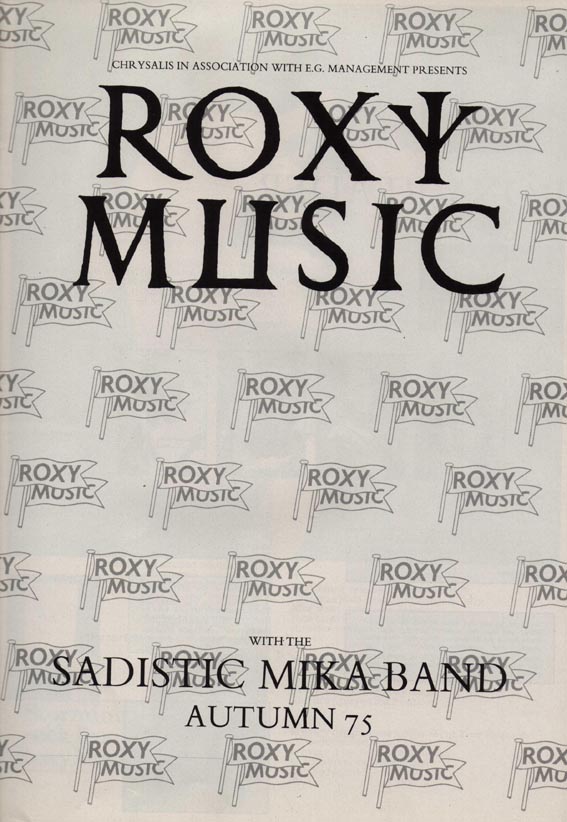
(via Soundsclips - first letter is a riposte to one Steven Morrissey!)


The Perfect Guitarist’
for Avant Rock Group
Original, creative, adaptable,
melodic, fast, slow, elegant, witty
scary, stable, tricky...
‘Roxy’ 223 0296
- Musician wanted advert, Melody Maker, 1971
There’s a certain sort of glam fan who never ceases to be blown away by the fact that Bowie played a character , the imaginary rock star Ziggy Stardust. That same certain sort of glam fan never stops being thrilled by the nerve and verve of Roxy Music giving a credit on their debut LP to the person who did their clothes, hair, and make-up. Supposedly this was a dissident blow against rock’s anti-fashion stance. Cutting through the stale dope-smoke fug of the hippie hangover, Roxy were “the first true band of the Seventies”. But they also prophesied the Eighties, their celebration of posing and artifice anticipating postmodernism, the New Romantics, The Face, pop video, and self-reinventing superstars like Madonna.
Which isn’t untrue, but isn’t the whole truth, either. It’s hardly the case that Roxy or Bowie invented the idea of image or were the first rockers to have close relationships with designers and stylists. Most 1960s British bands took rather an interest in clothes and hair. Nor were Bowie or Roxy’s Brian Eno the first flamboyantly androgynous figures in rock. On the record sleeve and in the promo film for “Have You Seen You Mother, Baby”, the Stones wore women’s clothing four years before Bowie put on a frock for the cover of 1970’s The Man Who Sold The World.
Still, it is true that around 1970-71, rock got awfully drab looking, with countless denim-clad blues-bore and boogie bands, dressed-down singer-songwriters and country-rock outfits, and virtuoso players too wrapped up in their endless soloing to bother with stage craft. “Everything went flat,” recalls Roxy Music guitarist Phil Manzanera. “A lot of musicians were getting strung out on heavy drugs. They were out of it, so they weren’t even bothering to wear kaftans or other hippie stuff, which had been stylish in their own way.” Then, with the emergence of Roxy Music and Bowie in 1972, “suddenly there was colour and exoticism and the spirit of rock’n’roll again. We supported Bowie at the Greyhound in Croydon, in June 1972: Bowie in his full Ziggy Stardust gear and us in all our regalia, performing to just 150 people in this little upstairs room. It was a tiny stage but it had theatrical lighting, so you had to wear make-up, because that’s what theatre people do, otherwise you look washed-out.”
John Lennon once quipped that glam was just rock’n’roll with lipstick. Glam historians tend to emphasize the lipstick at the expense of the rock’n’roll; they focus overly on the gender-bending rather than the genre-bending. In Roxy’s case, the attention paid to the group’s fashion world connections, Pop Art allegiances and other extra-musical credentials threatens to overshadow their achievements as a rock band. In truth, Eno’s feather boas, Bryan Ferry’s gaucho look of 1974... they really haven’t aged that well. It’s hard to believe that wearing a white dinner jacket was ever a big deal. Even the celebrated covers of the first five albums, with their lingerie-clad models, look cheesy and chauvinist these days (well, apart from the still-edgy sleeve of For Your Pleasure, a perversely stylized shot of Amanda Lear walking a panther). The music, though, remains timeless in its weirdness and wildness.
What gets swept under the carpet by the “first true band of the Seventies” argument is that the Roxy of the first three albums is a post-psychedelic outfit: as much progressive rock as glam rock. Phil Manzanera, the guitarist who responded to Ferry’s “Avant-Rock” ad and eventually got the job, recalls listening recently for the first time in ages to “The Bob (Medley)”: the six-part song-suite on 1972’s Roxy Music, a sort of “mini-movie” concept piece about the Second World War. “This guy is remixing our debut LP in 5.1 surroundsound, so I was listening to ‘The Bob” and I was laughing. It’s pure prog. The whole of that first album sounds so weird. It’s such a mish-mash of stuff. Roxy just wouldn’t get signed today.”
Those who view Roxy as pioneers of surface-deep postmodern pop regard the band as radically opposed to the earthy earnestness of what was then known as the Underground: long-hair, beardy bands like The Soft Machine and Family who played the college gig circuit, recorded sessions for John Peel, appeared on The Old Grey Whistle Test, got written up in Melody Maker. But Roxy’s earliest champions were, in fact, John Peel, who invited them to record a session for his show; Melody Maker’s Richard Williams, who got the hype ball rolling; management company E.G., whose other clients included King Crimson and ELP, and who hitched Roxy up with Island Records, the leading progressive label of the era. At one point Ferry actually auditioned to be King Crimson’s singer. And before Manzanera got the gig, the group’s guitarist was David O’List, formerly of The Nice, the original prog band.
Early on, Ferry went along with the progressive scene’s disdain for chart pop, declaring: “We’re not a singles band, really. I certainly don’t want to find myself sliding down the Slade/T. Rex corridor of horror”. Even in hindsight, he recalled that Roxy “didn’t think we were as commercial as what other people were doing.... When we started, I think we thought we’d be a kind of art student band, and that’s as far as it would go... King Crimson were one polar extreme, and Bowie was the other, and we were in the middle... I was astounded when we had a hit record.”
Over half the band–Manzanera, Eno, Andy Mackay, Paul Thompson--came from experimental music, trippy-proggy, or heavy rock backgrounds. “We had some weird things that other bands didn’t have, like someone playing oboe,” Manzanera says of Mackay, who was classically trained and whose keen interest in the avant-garde later resulted in the fine book Electronic Music. Manzanera’s previous band was Quiet Sun, an outfit influenced by Zappa, Pink Floyd, and Soft Machine, while drummer Thompson worshipped Led Zep’s Jon Bonham. A fan of minimalist composers like Steve Reich, Eno was a non-musician who supplied Roxy with irruptions of abstract synth and tape effects: things that were “part of experimental electronic music,” recalls Manzanera, “but we used them in the context of songs.”
The songs themselves weren’t exactly conventional either. Some, like “The Bob” or “If There Is Something” were more like several songs concatenated together. Others, like the first two singles “Virginia Plain” and “Pyjamarama” would be judged unfinished by the standards of hit factories like the Brill Building or Motown. Neither has a chorus, just a single verse melody repeated.
This minimalist aspect to Roxy came from one of the motley crew’s few shared passions: The Velvet Underground. But there were also upsurges of maximalism, acid rock flashbacks like the second half of “In Every Dream Home A Heartache”, with its phased drumming and gaseously billowing guitar. “That was my chance to vent my inner psychedelia,” Manzanera laughs. Even more far out is the title track/finale to For Your Pleasure, especially its hallucinatory extended coda of pointillistic piano trills, like the Milky Way going down the cosmic plughole. The product of the strong bond Manzanera formed with Eno, “For Your Pleasure” is comparable with Hendrix circa Electric Ladyland or Tim Buckley’s “Starsailor” in its use of the studio and recording tape as a canvas for sound-painting.
In late 1973, looking back at the first two Roxy albums not long after he was pushed out of the band, Eno enthused about the music’s “insanity... the element of clumsiness and grotesqueness”, the “terrific tension”, caused by the group “juxtaposing things that didn’t naturally sit together”. Even after Eno’s departure, Manzanera continued to pursue the absurdism and studio-boffin experimentation on the third album, Stranded. “Amazona”, for instance, is split apart by an indescribably strange guitar solo midway between a fire storm and a gigantic bubble machine. It sounds like the work of several guitarists, but it’s just Manzanera playing through a complex relay of of distortion, repeat echoes and vari-pitch using a specially built contraption that worked just once. That first and only take is what you hear on the album.
“Amazona” was the first song on a Roxy long-player for which Manzanera received a credit. Because music publishing operates according to an antiquated, pre-rock conception of composition that rewards those who write the top line melody and lyrics, the vast majority of Roxy tunes are credited solely to Ferry. “It’s very old fashioned, it goes back to Tin Pan Alley and the 1930s,” says Manzanera. “Eno’s synth part on ‘Ladytron’, Andy’s oboe parts—that came from them. Each member was contributing to the music and to all the arrangements. I like to think that we produced the musical context for Bryan to put his vision into. But that’s not reflected in the publishing.”
It’s all the more unfair because, according to Manzanera, from about half-way through For Your Pleasure and onwards through the remainder of Roxy’s career, the band would write “the music first—all the music, including the solos. Then Bryan would listen to it and try to write a topline tune and words. When it worked, it was absolutely brilliant. Because none of us knew what the song was going to be about until he recorded the vocal. Imagine, you’ve been working on ‘Love is The Drug’ for absolutely ages, with no idea that it’s even going to be called ‘Love is the Drug’. Then Bryan turns up, saying ‘I’ve been all night’, and he sings it, and we’re like, ‘bloody hell, we’ve got a single.’”
Rather than the players “backing” their singer/leader, then, it would be more accurate to say that Ferry fronted them: many of Roxy’s greatest songs would never have been written in the absence of what had been generated first by the musicians. Which is not to downplay the importance of Ferry’s “completion” role. Stranded’s high point “Mother of Pearl” would be a fabulous instrumental, but it would not have a fraction of its emotional power without Ferry’s words or his incredible vocal performance, where every line, every word even, is delivered with a deranged archness of emphasis, suffusing the entire song with bitter, poisoned campness. In purely musical terms Ferry’s greatest invention is his voice on the first two albums, the reptilian vibrato that paved the way for neurotic New Wave mandroids like Gary Numan and Devo. As much as the jarring and jolting music, Ferry’s grotesquely stylized singing contributed the aspect of “insanity” that Eno valued in early Roxy.
There’s no doubt that Roxy was Ferry’s “baby”. He formed the group, formulated its overall vision and framing. But curiously, what becomes apparent, as you follow the band’s arc through the eight albums (plus one double CD of B-sides and what-not) corralled in the new box set The Complete Studio Recordings, is that as Ferry gradually asserts total control over the band, the music becomes less characterful. The individual character of the players, that strange “mish-mash”/mismatch Manzanera speaks of, starts to fade, but so too does the collective character of Roxy as an entity set apart from the landscape of pop.
This smoothing-out begins to set in circa 1974-75 with Country Life and Siren. It’s in full swing with the reformed Roxy of Manifesto and Flesh + Blood, where Roxy are playing the game of pop according to the radio and dance-floor rules of the disco/New Wave late Seventies and early Eighties. And playing it well: there’s no denying the grace of “Oh Yeah” and “Over You”, the shimmer ‘n’ shiver of “Same Old Scene”.
Oddly, the same syndrome affects the lyrics: the verbosity and over-ripeness of the early albums goes, but so too does the imagistic vividness, the unclassifiably mixed emotions. “Songs like ‘Mother of Pearl’ had masses of words,” recalls Manzanera. “In Roxy’s first five years, there’s a lot more witty metaphors and wordplay. But it got more serious gradually and by the end you had a bunch of haikus, virtually.”
By Avalon and its big single “More Than This”, the sound is all patina, glistening with professionalism and perfectionism. The words sketch the barest suggestion of mood; the voice, once so blood-curdling and startling, has become a debonair croon, evokes just a faded and jaded gentility. Ferry has not just annulled the personalities of Manzanera and Mackay, who might as well be session players like the other hirelings credited, he’s erased himself too. Immaculate background music, Avalon could be seen as Ferry’s own version of ambient music: an “I can do that too” riposte to Eno’s reputation as doyen of the cutting-edge. A triumph, in its way, but also a tragic inversion of everything that made Roxy so arresting.
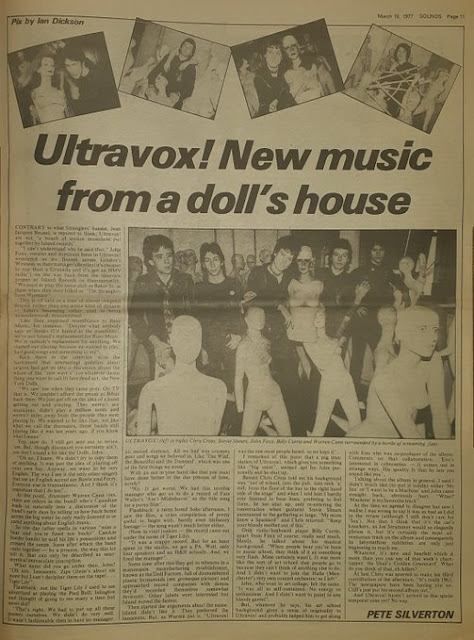
"Ultravox’s sound incubated in the Doll Factory –a perfect name for their rehearsal space, given its echoes of Warhol and New York Dolls. It was literally the premises of mannequin manufacturer Modreno, located in an old warehouse in a seedy area behind London’s Kings Cross station. (John Foxx had met the guy who ran it when they both worked painting the faces of showroom dummies at another company). Ultravox rehearsed in the big room, surrounded by “dismembered plastic humanoids”: an ideal environment to hatch songs influenced by dystopian science fiction writers like J.G. Ballard and a sound that would ultimately evolve into robotic synth-rock." - from S+A
Around the same time....


The pic disc of the album had the mannequins in the nuddy


The singles off Manifesto continued the 'living doll' thematic


While this generic (I assume) sleeve for the American release of "Angel Eyes" fits with the general vibe of artifice, fetishism and retro-glamour

Irresistible as always in this context to think of "the sex appeal of the inorganic", Roxy Music's "In Every Dream Home A Heartache" and its (accidental?) semi-rewrite as Ian McEwan's 1977 short story "Dead As They Come"....
Earlier post on the Roxy Girls and the nude mannequin picture disc version of Manifesto

I didn't know the music journalist and author Mark Spitz - who has died tragically young - very well, but I always enjoyed chatting...