a book about glam rock and art pop - 1970s mostly - but also tracking its echoes and reflections through the 80s, 90s and into the 21st Century - footnotes to follow here soon
Where punk has glam running through it like jam in a Swiss Roll - anti-fashion is only glamour turned inside out - New Wave seems to me the actual anti-glam backlash - the reign of the ordinary bloke and blokette. A parade of only-a-mother-could-love faces (sometimes only-a-mother-could-bear voices too) in clothes that often seem to mock the idea of style or elegance, whether scruffy or showbiz-parodic. Facially, instead of alien beauty, it's the genre of geeks and speccy gits. Kooks and inadequates. Spudboys. People who ought to have never had the remotest chance of being in pop music, actually finally got their chance to be in pop music.
Lyrically likewise, there's a relentless emphasis on the mundane and the quotidian... Routine, office work, commuting, suburbia. The Members's "Sound of the Suburbs" and "Solitary Confinement", Jona Lewie the unsmooth operator hiding in the kitchen at parties, The Chords singing about English commuter belt drones who swallow their dreams like their beer.... Madness with their "Grey Day"s and "Cardiac Arrest"'s happening to briefcase-wielding commuters on the double-decker bus. Emotionally, the registers are bathos and pathos (Madness again - "Embarrassment"; the sheer genius of a song about the awkwardness of a teenager going to the chemists to buy his first packet of rubber johnies("House of Fun"))
And all of that is what's good about New Wave. The bubble of fantasy punctured. The plodders and the mis-shapes get their moment. No more heroics. Anti-stars.
Here's a song from a bunch of Noo Wavers (whose record covers I must have flicked past a hundred times) that's actually about stardom and being a no-mates loser.
Fabulous Poodles turn out to sound less pathetic than I'd always imagined from the name and the look - vocally a little bit Wreckless Eric, which I like... violin that's a tad Doctors of Madness.. , tiny bit of talk box which makes me think of "S-S-Single Bed" by Fox - but still falls some way short of making me want to investigate further
I mean look at these album covers
Here's a late-glam era group with a song about in-the-mirror play-acting wannabe-stars, supposedly inspired by Bolan, a friend of Steve H's
Although I say "late glam", Cockney Rebel look even more gorm-free in that get-up than Fabulous Poodles
Here in this American Bandstand clip, the Fabpoos are done up in ironic "entertainers, we" outfits.
"We're all losers on the dating game" says the singer.
I suppose that look is coming out of Deaf School maybe (a group on the edge of late glam / New Wave) (shades too of Sailor or Kursaal Flyers)
In this FabPoo clip singer's got a sparkly jacket - to be taken as a kind of anti-theatrical joke, I think, indicating the mutual discomfort between band and audience about the very idea of performance. "It's showtime!"
This murky - faintly menacing - advert seems to be still trying to sell Marc Bolan as an underground act, even on the eve of his pop superstardom. You can barely see his pretty face, let along any glitter on the cheekbones.
The musician, barely identifiable as Marc, is totally self-absorbed, wrapped up his own sound and his own cool. He's not meeting the gaze of a potential audience.
It's totally out of step with the direct appeal to tweenage girls of the song itself ("I don't mean to be bold but may I hold your hand?" - courtly love vassalage reframed in 12-bar boogie), the luscious cloying caramel-sweetness of the "la la la la-la la-la" hook / fade-refrain ...
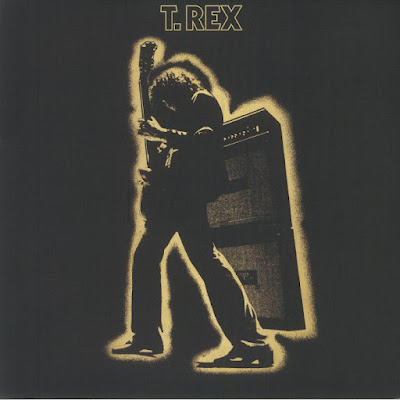
Likewise the cover for Electric Warrior is "heavy". Face hidden by long frizzy hair... guitar perpendicular and phallic... The musician is lost in the auto-erotic swirl of the awesome noise he's generating, inwardly focused on his playing, his masturbatory mastery of the instrument, barely aware of the audience... Bolan is presented as guitar-hero (a warrior armed with electricity - that massive amplifier behind him blasting out pure power). He's an active noise-maker not a passive object of desire, a fey plaything. It could be a cover for a Paul Kossoff solo record.
“For three or four years Marc Bolan and I were kind of best friends, along with his wife June and my wife Sheila. We used to go off and do hippie things at weekends – Stonehenge or Glastonbury Tor. And I used to get Rex loads of gigs. I’d get booked in somewhere as a DJ, and I’d ask, “Can I bring this band with me?” We spent a lot of time together..... When Marc saw the doors he’d been banging on for so long suddenly start to open, he did go a bit mad. It was one of those things where I phoned up to see what we’d be doing next weekend, and somebody answered the phone and said, “Look, Marc’s very busy. Can he call you back?” And then he never did. You feel mildly offended, but life’s too short” - JP
Plee, in his Disc & Music Echo singles columns, reviews new 7-inch platters by his erstwhile bosom pal Boley.... in the first instance here (3rd July 1971) letting personal bitterness cloud his judgment a tad, I suspect, although who could blame him really....
The three B-sides, which I can't recall ever hearing, do indeed mention bosoms:
"Lady, I love your chests ooh,
Baby, I'm crazy 'bout your breasts"
and
"Baby, I love your chests ooh,
Lady, I'm crazy 'bout your breasts"
More measured here (6th May 1972) - and literally measuring - Peel counts the number of times the words "metal guru" appear in the song (it's a lot).
Kingsley Mole sat high on a windy knoll, his eyes consuming the silent midnight woods. He nuzzled his long molish snout deep inside the heart of a marigold and let his molish imagination skip to and fro over sunken galleons and pirate pictures of rusted doubloons and deep-water cabins stacked to the brim with musty muskets and goldfish gauntlets once worn by Henry Morgan
The lark awoke and doffed its plumed three cornered hat to its own sleepy-eyed reflection, then it hopped past the crested nest of the snoring cuckoo and flew off into the Lionel Lark morning looking for friend Mole
Mole was on a marigold comedown and sulkily scraped bluebeat rhythms with his ground-digging paw
"Yes," he whispered, "Me and Li are going a-questing for the Lilly Pond of Fox Necks."
Li'll know all the mapping gen[??], so the mole, kneeling on the soft soil, said a morning prayer to Ra, not even caring if he dirtied his yellow Rupert trousers because his molish mind knew that praying was special
Vicious, interviewed by Vermorels, on Who Killed Bambi, Russ Meyer, The Great Rock'n'Roll Swindle etc
Q: What sort of films do you yourself like?
SV: I don't like any sort of film. I hate films.
Q: What it is about them that you hate?
SV: Because people have to act parts in them. Play people who they're not, do you know what I mean? And it's pretence, it's lies, it's just shit. It builds things up to be not what they are. Like if you filmed a day in the life of me, for instance - like a day in the life of a pop star, right - and you saw him going around in a flash car and whacking up smack and doing this and that and the other, and like a day in my life is like getting up at three o'clock, going to the office and hustling ten quid out of Sophie or something and going, and fucking going somewhere and waiting hours to fucking cop some dope, you know what I mean? And like that is the most boring thing on earth. It's as boring as sitting at home and drinking beer or fucking any other shit thing to do, you know what I mean. And like films are about lies, they're about making things look glamorous. And nothing's like glamorous, everything's a load of bullshit. And it makes me sick to think that people will act out parts and, you know, like make it all seem larger than life, just so that some crud out there can get off on some fantasy: that life is wonderful really and one day.... You know when I was like ten years old and when I used to... think that Marc Bolan was great, and I used to think to myself what a wonderful life Marc Bolan must have, just think. And if only I could be like him, gosh, just think of the things he must do. And like I do the things that he done before that stupid bitch crashed his fucking mini for him, or something, and like he probably did exactly the same thing as what I do now; sit in my mummy's front room cos I don't have anywhere to live.... It's fucking full of shit and I hate it all. But there's nothing else to do. It's better than doing nothing at all and it's certainly better than doing something I don't want to do.
Sentiments redolent of Holden Caulfield's in The Catcher in the Rye -
“If there’s one thing I hate, it’s the movies. Don’t even mention them to me.”
"I hate actors. They never act like people. They just think they do...if an actor acts [a part] out, I hardly listen. I keep worrying about whether he's going to do something phony every minute"
"If you do something too good [as a thespian], then, after a while, if you don’t watch it, you start showing off. And then you’re not as good any more."
Guitar Worldinterview withTony Visconti on the criminally underrated licksmanship of Marc Bolan
choice morsels:
Visconti's fondest memories of producing T.Rex
“I loved that the sessions were very live. I also loved the fact that he dressed to record. He wore his stage gear and his platform shoes. He’d be jumping up and down like he was on stage; everything was really great fun. We also invited friends to the sessions, so he liked to see maybe five or six people bouncing about in the control room. He always loved an audience.“
"Everything you hear on a T. Rex record was a live recording; nothing was replaced later on.
"He listened to the early blues players a lot. We both loved R&B and Little Richard. Little Richard was a huge inspiration to Marc. Marc turned me on to James Burton, those great solos on the Ricky Nelson singles.
"His technical knowledge guitar-wise was not great at all. He knew a handful of chords, the right ones, of course, for rock ’n’ roll. He invented his own technique with that very fast vibrato – he had very strong hands.
"He was cut from a different cloth; he invented himself. He had his own thing. To compare him to Ronson and Fripp and others I’ve worked with is difficult as his recording career was too narrow. Ronson worked with loads of other people so you get an idea of where he stood and how he could adapt his style. We can’t make that comparison for Marc because he never really played with other artists. Marc is criminally underrated as a guitarist. All rock ’n’ rollers love T. Rex, and there’s a little bit of T. Rex in every rock ’n’ roll band.“
worth a read for interesting stuff about the use of strings on the records and the backing vocals from Flo and Eddie
it's already too long as a book, but S+A could have done with a chapter, or appendix, on disco as adjacent to glam - its cousin in so many ways: artifice, showbiz, razzle, escapism, narcissism, decadence, polysexuality, science fiction, fabulousness, fantasy, camp, proto-retro (covers, period looks, fancy dress)
the future-retro mish-mash a particularly shared attribute
and Chic were actually influenced by Roxy Music - the image and styling more than the music
Then again, there's another sense of "discoglam" - glam rockers going disco
The lighting in that seems to be an attempt to pictorialize the space of fame itself. Nice job, Cher show lighting technician!
Glitter's abject attempt to do a Young Americans - complete with Luther Vandross on backing vocals
And this sad moment in the downward arc of a superstar - credited to T.Rex Disco Party
x
A bit better - slow'n'lowdown funk - let's say "supernotbad"
"That song, released in 1979, became one of the most influential songs in gothic rock music, even though they saw themselves as a "dark glam" band and have always distanced themselves"
Love and Rockets, offshoot of Bauhaus, also continued the glam thing with this T-Rexy-sexy song, which was actually a very large hit in America, would you believe? D.Ash and P. Murphy belong to this English pop archetype - the darkly pretty boy (although often they're not actually that pretty, it's all eyeliner and hair products).
In pop, it begins with probably with Barrett and Bolan (although almost certainly having precursors in other earlier art forms and cultural milieux), and then carries through with Murphy and other Goths sexgods (Ian Astbury, although he's not willowy enough really - too strapping and virile) ... and then into the Nineties with Placebo... and then the lineage resurfaces in a completely different field of comedy (albeit close-linked to music) with Russell Brand and Noel Fielding. A memoiristic out-take from an early draft of the T.Rex chapter in Shock and Awe: The
party was going to be legendary. It was
being thrown by a friend whose parents ran a boarding school near Ipswich and
were away on their summer vacation. The
idea of this place of education being so deserted and divested of authority was powerful enough to pull us a
considerable distance across England. Excitement mounted on the coach journey
and the long walk through fields from the bus stop to the school.
But
the build-up turned out to be more thrilling than the party itself. It took
place in the headmaster’s house, as opposed to spilling riotously through the
classrooms and into the gym, and, while packed, consistently mostly of people
milling around and drinking. Nothing really ever happened. Certainly nothing like
mayhem. Only two things stick in my memory
about the night. One was attempting to sleep in a bath tub, like I’d seen in
the movies, and discovering it doesn’t work. And the other was the boy dancing
to T. Rex.
We
were sat in some kind of side-room, a
little bored and not nearly drunk enough. And then this young man, in his early twenties
probably, put “Get It On” on the record-player and danced, sinuously and
seductively, I recognize the boy now as a type: darkly luscious, willowy, imp-of-the-perverse
glint in the eye. An English archetype, running from Syd Barrett and Mark
Bolan, through Peter Murphy and other Goth male singers... well, to Noel Fielding and Russell
Brand. The boy wasn’t dancing as encouragement for us
to join him, he wasn’t trying to get the stalled party started. He was dancing
purely for display – splaying himself as an object for visual delectation, a
plaything for our gaze.
I
wasn’t turned on exactly, but I was entranced: at once admiring and envying the
feline self-confidence it took to preen, prance and pose like that. A dance
done in a mirror of people, the performance spoke to something inside me, in
much the same way as the strange shapes thrown by another charming man,
Morrissey, would, a year or two later on Top of The Pops. I knew “Get It On,” of course, but it felt like years since I’d heard it. T. Rex had been so massive for three years in the early Seventies that, like the Beatles and The Stones, they’d never faded from pop consciousness altogether. But in the early Eighties, Marc Bolan wasn’t really present as a reference point or resource for current musicians, unlike David Bowie and Bryan Ferry, pervasive influences throughout New Pop and New Romanticism, from their vocal style and hair to their strategies and sensibility. Just about the only glimpse of Bolan-reverence in those days was when Bauhaus, the band fronted by Peter Murphy, covered “Telegram Sam”. But that was just a prequel to their more famous cover of “Ziggy Stardust”, which got them on Top of the Pops. In 1983, singles by T. Rex and other glam groups were deejay favorites at The Batcave, the hub of the germinal Goth scene. But really, that was about it until later in the decade, when The Smiths put out some blatantly T.Rexy-sounding singles, while house producer Baby Ford attempted to refurbish “Children of the Revolution” as a rave anthem....
A bit on Bauhaus from Shock and Awe:
October 1982 – Bauhaus’s single of “Ziggy Stardust” lands the Goth group
on Top of the Pops, where Peter Murphy reenacts Bowie & Ronson in
the form of some stylized homo-erotic interplay with guitarist Daniel
Ash. On the B-side, there’s another glam homage: a cover of Eno’s
proto-punk rampage “Third Uncle”. But this isn’t even their first glam
tribute: in 1980 Bauhaus put out a single of Bolan’s “Telegram Sam. Speaking to
Seconds magazine, Ash recalls how he and Murphy worshipped Stardust-era
Bowie: “It wasn't a sexual thing, it was aesthetic, a beautiful thing to look
at. … It was like I'd never seen that before, some sort of alien --is it male
or female?” Bauhaus and their idol soon coexist in the same filmic
fantasy-space thanks to The Hunger. The 1983 movie opens with
Bauhaus performing their foundational Goth track “Bela Lugosi’s Dead” in a New
York nightclub, into which vampire lovers John and Miriam –Bowie and Catherine
Deneuve – prowl in search of prey. The credits roll over Murphy’s gaunt
beauty, intercut with Bowie and Deneuve’s faces as they silently and coldly
select a pair of pretty things on the club floor to lure home. Back-dropped by
Bauhaus’s contorted poses, one credit is for “Make-Up Illusions” - a perfect
Glam-Goth moment.
A bit on Bauhaus from Rip It Up and Start Again
Their 1979 single “Bela Lugosi’s Dead”--generally identified as the ground zero of Goth proper--appeared in Bowie’s vampire flick The Hunger; Bauhaus performed the song in a nightclub scene, Murphy writhing in a cage. The Bowie-clone tag, based largely on Murphy’s mannered vocals, proved impossible to shake off, and in the end Bauhaus tried to exorcise it through the sardonic gesture of covering “Ziggy Stardust” with exacting fidelity. When they appeared on Top of the Pops to mime “Ziggy” in 1982, Murphy and guitarist Daniel Ash even replicated the
saucy homoerotic interplay between Bowie and Mick Ronson.
Murphy’s striking looks--teeteringly tall, gaunt, with a bruised pout and perfect cheekbones--made him a Goth pin-up, the ultimate erotic enigma. But what came out of those luscious lips was portentous and preposterous, an overblown farrago of sex and death, religion and blasphemy. Raised Catholic, Murphy kicked back against his upbringing with sacrilegious ditties like “Stigmata Martyr”, which featured him reciting “in the name of the father and the son and the holy spirit” in Latin, and was accompanied live by simulated crucifixion postures.
With their shock-rock gestures and guignol grotesquerie, Bauhaus were actually far closer to Alice Cooper than David Bowie: exciting, but difficult to take seriously. They had a superb grasp of rock-as-theatre, using stark white lighting to cast dramatic shadows. “It's important to go to the theatre and escape from the street, use the space, find another element,” Murphy told Melody Maker.
Like Cooper, they made flashy, thrilling singles--the dark, twisted artfunk of “A Kick In the Eye”, the swirling vaporous mystery of “Spirit”. Ash’s guitar bore comparison with Gang of Four or Joy Division at their most harsh and hacking, especially on Bauhaus’s early postpunk-aligned efforts like “Terror Couple Kill Colonel” and “Bela Lugosi’s Dead,” with its fret-scraping guitarscree and metallic dub effects. But the albums sagged under the weight of ponderous pretensions.